

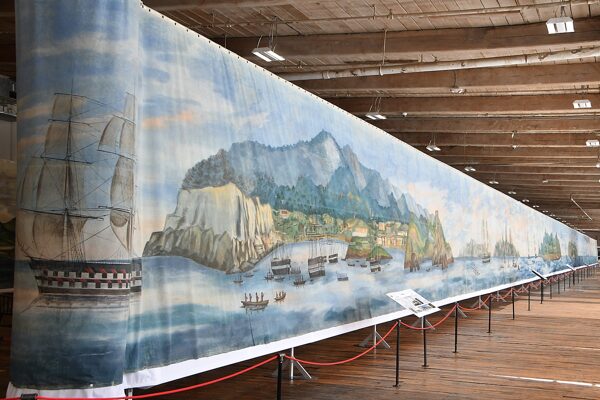
Before our present era of AI slop, before sitcoms and Hollywood blockbusters, before Saturday morning serials, soap operas, Technicolor, Cinemascope, Panavision, Smell-O-Vision, Sensaround, CD, DVD, Blu-ray and 8K – before all that noise – there was an earlier, wildly popular form of entertainment that delighted millions around the world, made its promoters hugely wealthy, and which today few people know ever existed.
The Moving Panorama
This was the era of the ‘moving panorama’. Imagine a vast painted canvas, actually a long bolt of fabric wrapped around two giant spools. A simple mechanism, hidden from the viewer sitting in the audience, drove the turning of the spools while the moving images were illuminated from behind as they were steadily revealed across a stage.
Audiences were spellbound with wonder and joy. Here the entire world was spread before them as they took a journey of the imagination. The effect could be even further enhanced if the panorama moved behind a stationary actor on the stage, making it appear as if he were flying across the sky on a winged horse.
Journey Down the Mighty Mississippi
The most famous original example of the moving panorama – the one that really launched it into the big time – was a “three mile long” (probably not really that long) canvas painted by John Banvard around 1840, depicting an epic riverboat trip of 1200 miles up and down the Mighty Mississippi River, including past your humble writer’s hometown of St. Louis, MO.
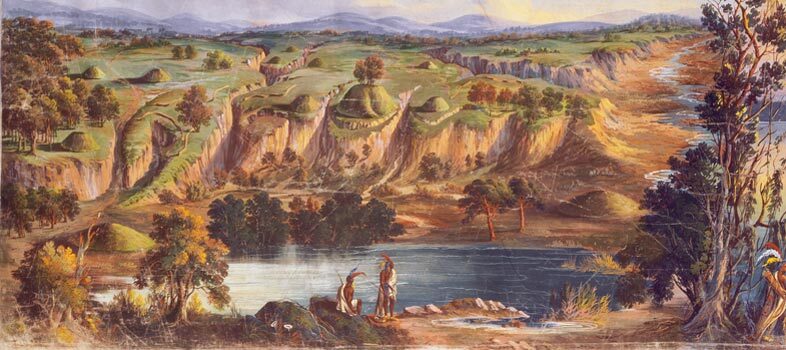
Beginning in the badlands of the Dakotas, it showed a romanticized version of the early life of settlers and pioneers, Indian camps, cavalry battles, bucolic farmland, rolling forests, ancient caverns, and the frolicking city of New Orleans at the journey’s end.
Soon panoramas were all over Europe and America, in towns large and small (and because of their success, there was a lot of open plagiarism, sabotage and other skullduggery that came along with them.)
They were shown in private ballrooms, churches, town halls and huge theaters. Beloved by commoners and royalty alike, moving panoramas provided the welcome illusion of travelling to exotic locales such as the Antarctic or the mysterious Far East – places the vast majority in the audience would never get to see.
Most are gone, long gone. However, a few still survive, including the longest in America, The Grand Panorama of a Whaling Voyage ‘Round the World, circa 1848. It’s 1,275 feet long (greater than the height of the Empire State Building) and was recently restored to its ancient glory by the New Bedford Whaling Museum in MA.
Banvard’s original Mississipi voyage, alas, eventually fell out of favor as the general novelty wore off. It was cut up into hundreds of strips and used for packaging, insulation and who knows what all else. The indignity of it. Other panoramas fell into dust, were eaten by moths, or went up into flames – a common enough hazard in those days.
Obviously “moving panoramas” evolved into “moving pictures” and finally true cinema. The same tricks of motion were first recreated using pre-recorded backdrops, then green screens, and now full-on CGI. When the current love affair with novelty begins to fade, these too will be replaced, but with what? Neural implants, most likely. Me, I’ll stick with books.