Custom Rapid Tooling Services
Rapid tooling lets product developers transition quickly from a validated plastic prototype to production. Rapid plastic injection mold tools from Procision offer volume flexibility while limiting your financial exposure, yet you never compromise on quality or consistency.
- ISO Class 8 Clean Room
- Full DFM & Global Technical Support
Experienced Toolmakers
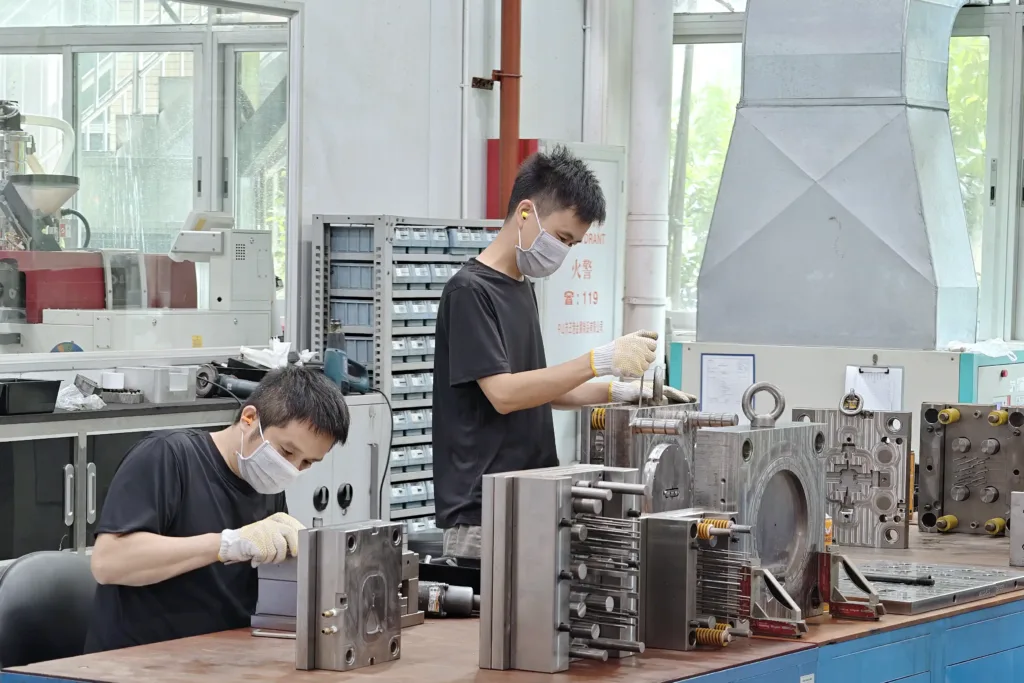
Our master machinists have broad experience making complex mold tools to close tolerances and on tight deadlines.
Turnkey Service
A complete manufacturing platform featuring multiaxis CNC milling and turning, sink and wire EDM, positive material identification, DFM optimization and final T1 approval.
Comprehensive Size Range
We are fully equipped to build tools and offer complete injection molding services from 10 tons of clamping force up to 250 tons. Greater capacity is available – just ask!
DFM Toolmaking Optimization
DFM analysis including MoldFlow digital simulation improves molding outcomes while lowering costs and reducing production lead times.
Get a Rapid Tooling Quote and Project Review
Our team of technical professionals is ready to assist.
Why Partner with Procision Manufacturing?
Complete Material Library
Our rapid tools are made from reliable P20 or NAK80 tool steel. These easy-to-machine steels can be paired with literally hundreds of resin types to yield finished parts to service virtually any application or environment.
Professional Quality Assurance
How do we help you meet your regulatory and quality goals? By offering scientific material identification, chain of custody documentation, and final quality assurance test and measurement reports on all tools and finished parts.
Support At Every Stage
Our rapid tooling services are just one way we support your product development journey. From custom rapid prototypes to high volume serial production, we have a stable manufacturing platform that effortlessly scales up with you.
Global Delivery Simplified
We ship worldwide with trusted logistics partners via our preferred AEO customs clearance. No bottlenecks – just fast, traceable delivery of compliant parts, anywhere you do business.
Common Questions
Procision Rapid Tooling Service — Frequently Asked Questions
Is all toolmaking done in-house?
The majority of our toolmaking and injection molding services are done on-site. Occasionally, due to capacity restraints, we work with our partner facilities that have been fully vetted by us and operate under our strict production and quality control guidelines.
How long does it take to make a rapid tool?
Much depends on the complexity of the part design and related features such as cooling circuits, number of cavities, ejector pin layout and the like. However, P20 and NAK80 tool steels are considered relatively soft, so they can be machined quickly and efficiently. Once a design has been finalized, a finished tool can be ready for T1 testing in 20 days or less. These are full featured tools, not requiring any compromises on design or performance.
What is rapid tooling, and how quickly can it produce T1 injection-molded samples?
Rapid tooling provides a quick-to-market tooling solution that uses soft steels like P20 or NAK80 steel. After design approval, Procision can provide T1 samples in as little as three weeks or less, depending on mold geometry and specifications.
What are the benefits of Procison’s rapid tooling services?
Rapid tooling offers many advantages. Soft tools are faster and easier to machine than fully-hardened steel and they are less expensive. You can validate a new product design and get to market more quickly while limiting your capital investment. Yet you still have the capacity to run thousands of cycles with complete confidence.
What types of parts can be made with rapid tooling?
Any type of part that can be made with a high volume tool can also be done with a rapid tool. “Rapid” refers to the use of relatively soft P20 or NAK80 steel, which can be machined quickly using standard CNC milling and EDM machines. Because this material isn’t hardened it tends to wear faster, especially in the presence of aggressive resins. This can be a limiting factor for complex designs that have sharp cutoffs and high clamping forces – the very factors that cause a tool to wear prematurely.
What materials does Procision use for rapid tooling?
Procision uses P20 and NAK80 steel to make rapid tools. Some suppliers use aluminum, which is also easy to machine but is much less durable. Our tools can be paired with all standard commercial resins so there are no limitations on finished part performance.
What are the benefits of soft vs. hard tooling?
Soft tooling refers to tooling raw material that hasn’t been heat treated. This includes P20 and NAK80 steel and can also refer to other hybrid processes like metal-infused polymer plastic molds or sintered metal.
Soft tooling tends to be easier and faster to machine and can be put into service right away. Contrast this with hard tooling, which must first be machined, then heat treated and annealed. Once a tool has been heat treated it’s immensely tough and can only be further machined with EDM electrodes. Such tools are more expensive and time-consuming to make but are far more durable.
Soft tooling vs. hard tooling: which is better for prototype and production volumes?
Procision recommends easy-to-machine P20 or NAK80 steel for prototypes and low-volume production. This reduces your initial investment and time to market while still providing excellent results. The main limitation is that soft tools will wear out more quickly, though they can still be good for many thousands of cycles.
For serial production, we use heat-treated S136 or H13 tool steels, which are much more durable and can withstand hundreds of thousands or millions of cycles. It’s always best to consult with our specialists in advance to discuss your exact requirements.
Ready to Start Your Next Project?
Our technical team is ready to help