
Safely ensconced within my sacred vault of personal archival history (a plastic box in the back of my closet) lies entombed for all posterity my first elementary school report card. Mrs. Tines noted, correctly, that “Chris has trouble tying his shoes.”
This is still true today, but that hasn’t discouraged me from a lifelong fascination with knots, knot tying, ropes, cordage and other matters string-like.
Vines, gut, thread, string, rope, cable, cords, yarn – whatever you call it, rope is likely among the earliest of tools that mankind used for construction, hunting, warfare, counting, communication, religious ceremonies, delineation of rank and privilege, decoration, and just to mess around with. But rope can’t do much all by itself. It really needs a knot or two.
If you’re at all curious about how things work – and you should be – then you may quickly find yourself twisted in knots when you start exploring this subject with any rigor.
For example, you might ask how many knots there are. Nobody knows. Ashley’s Book of Knots (1944) is still the reference on the subject, and it lists 3,900 useful knots for ships and sail rigging alone. More are being invented all the time for different purposes, and there’s some lovely jargon associated with rope work: belay, surge, bight, bend, slip, overhand, standing part, pay out, whipping, seizing, jam.
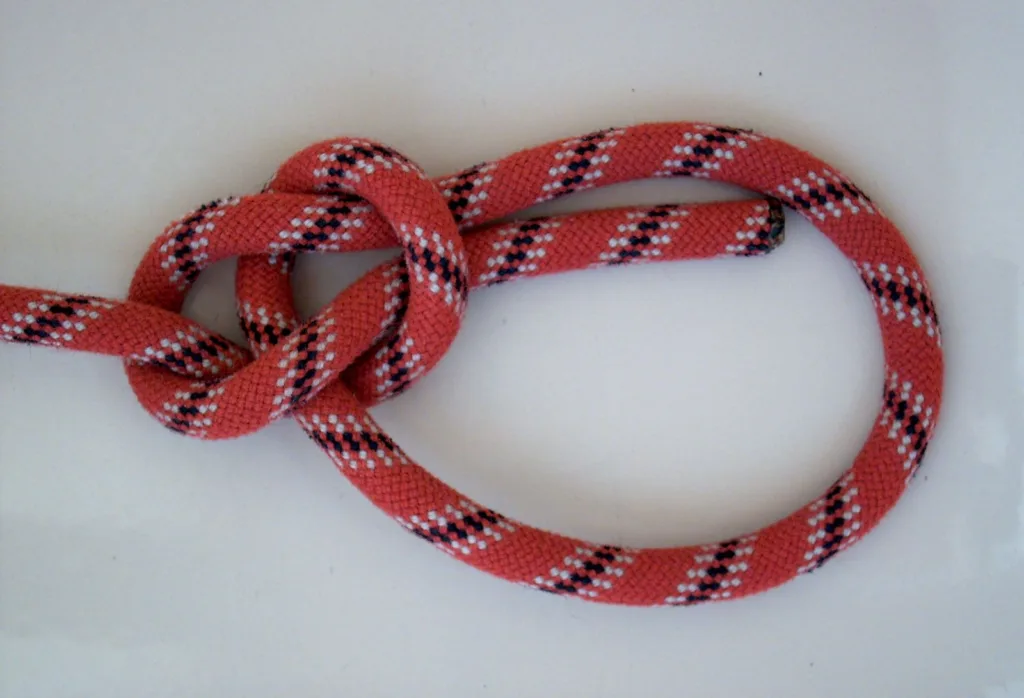
The king of knots is of course the bowline, the very knot that Roy Scheider has such a tough time with in Jaws. Learn it, and learn it well.
If you want to keep up then consider joining the International Guild of Knot Tyers. (I for one am delighted to know there are still guilds about anything these days and I heartily endorse their renaissance.)
In mathematical theory a knot is a closed loop in 3D space. Knots are counted by the number of lines and potential crossings – add more lines and you’ll quickly get infinity. Knot theory isn’t just nerdish fun – although it is that. There are practical applications related to cryptography, protein folding, and even the ultimate nature of reality (string theory, anyone?)
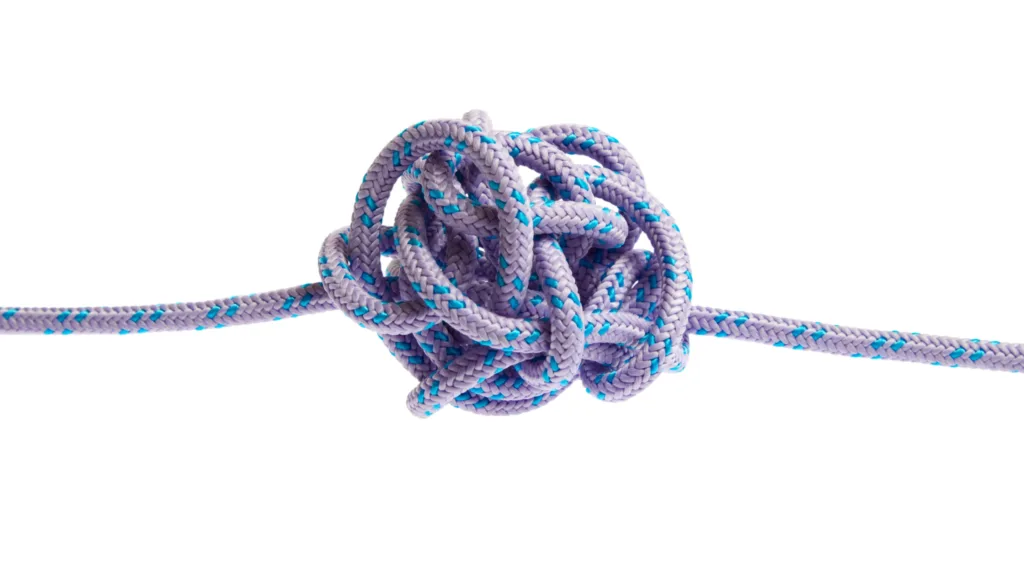
Knots can be dizzyingly complex and there are a surprising number of systems for categorizing them. Consult the knot index (www.katlas.org) if you have a few years to spare. For myself, I like the colorful and evocative names: granny, square, marlinspike, Turk’s head, sheep shank, bowline, blood knot, water knot, Chinese button, cow hitch, lark’s head, and hangman’s knot, to name but a very few.
Make no mistake. Despite the sometimes flowery language, knots are engineering in a very pure form. They’re deliberatey designed to serve a specific purpose and they’ve proven their worth over thousands of years and millions of applications.
I started meandering down this road recently because I came across an article about China mass-producing T1200 carbon fiber thread. This thread is ten times thinner than a human hair, and 120,000 strands of it can be wound together to make a 2mm rope that’s immensely strong. In fact there’s quite a lot of international competition, both strategic and commercial, to come up with new ways to mass manufacture high-tech fibers for purposes both quotidian and nefarious.
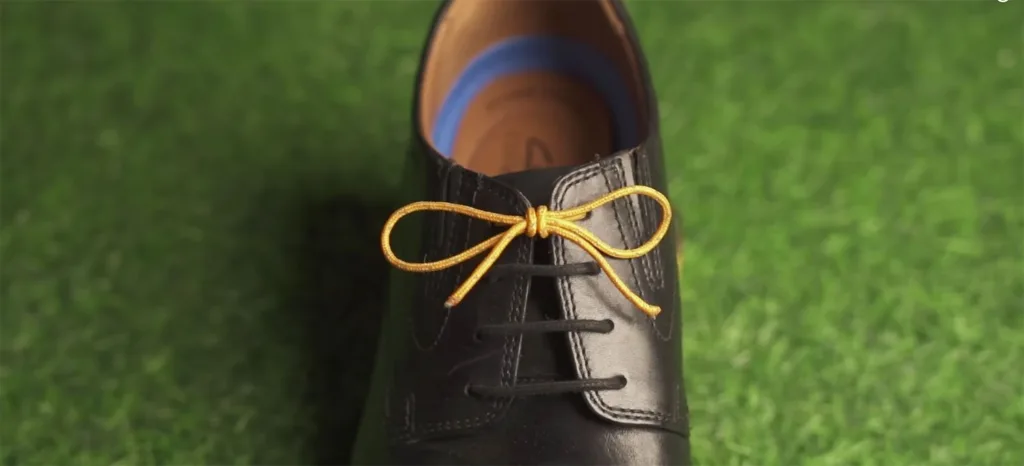
Which brings me back to tying my shoes. That shoelace knot you’ve been tying all your life? It’s technically called a slipped reef knot, and it sucks. Always coming loose, and it looks sloppy. Instead, try the Berlutti knot. It’s what all the cool people do.