

Picture the scene if you will. It’s late December 1959. You’re amongst a distinguished group of physicists – all members of the American Physical Society – enjoying the remains of this last dinner of the year, served courtesy of the good people at Caltech University in Pasadena, California.
The details of the menu that evening haven’t been preserved for posterity, but what was saved – and even then, only barely – was the after-dinner talk provided by the great Richard Feynman. The now-famous lecture, “There’s Plenty of Room at the Bottom,” was meant as an invitation to consider new applications for mechanisms on the small scale.
The transcript is worth reading in its entirety foreshadowing nanotechnology, microscopic computer chips and much else.
The Challenge
But what concerns us today are the two wagers made by Mr. Feynman that evening. The first was a promise of $1000 (about $11,000 today) of his own money to the first person to engrave the Encyclopedia Britannica on a pinhead. He reasoned that this could be done by manipulating light waves with lenses and mirrors – and naturally, he was eventually proved right.
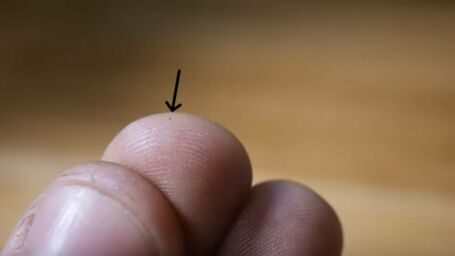
The second was an additional $1000 to anyone who could build a working electric motor of 1/64” square (~400 microns) or smaller. If it could be done, it would be the smallest motor ever made. *
Challenge Accepted
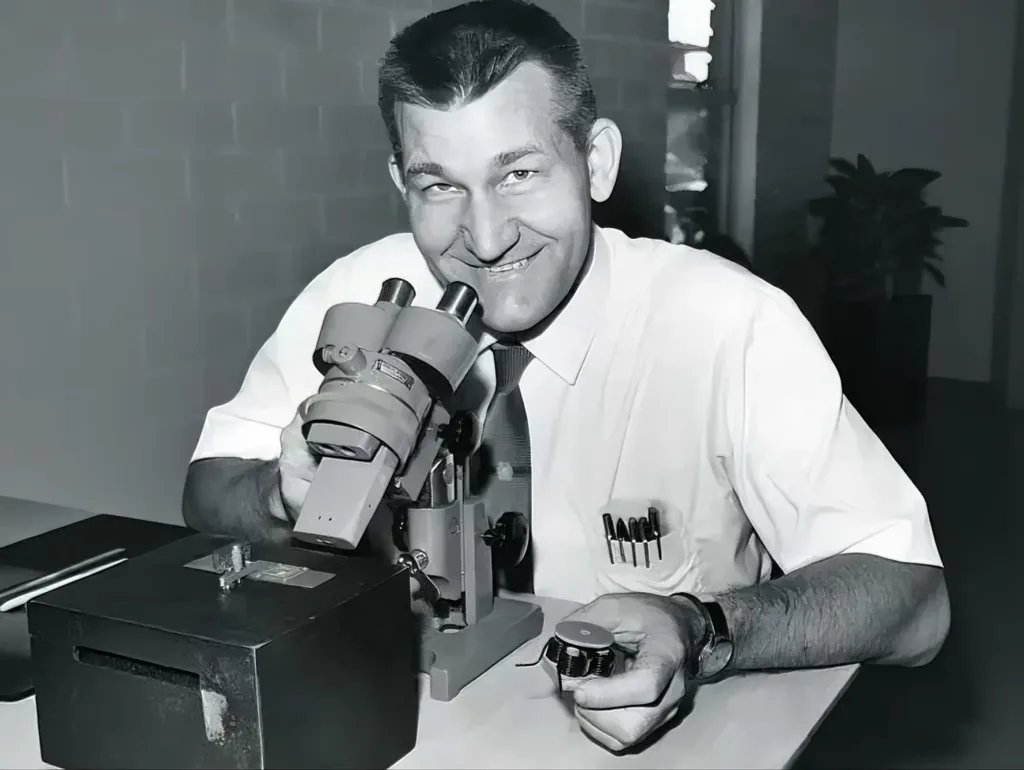
Rising to the second challenge was a then-unknown Caltech mechanical engineering graduate named William McLellan. He designed and built a simple working motor that to this day has never been equaled.
But how? In 1959 there were no digital CAD files, no CNC machines, no stereolithography, no photoetching. He wasn’t a specialist in electronics and had no machining experience. But he did have experience working with galvanometers, which are sensitive meters used to detect small amounts of electrical current. And as it happens, many of the people who built galvanometers at the time were former watchmakers.
The Watchmaker’s Lathe
Essential to this project was the use of a precision Swiss-type watchmaker’s lathe – the most accurate machine tool available at the time. This type of lathe allows the operator to make exceptionally fine cuts while carefully holding even tiny cylindrical stock without destroying it in the process of machining. They are, by the way, still beautiful and useful machines today.
McLellan contacted his former colleagues and, from them, got a crash course in machining on the small scale. Then, borrowing a lathe, he got to work building his design.
The Prototype
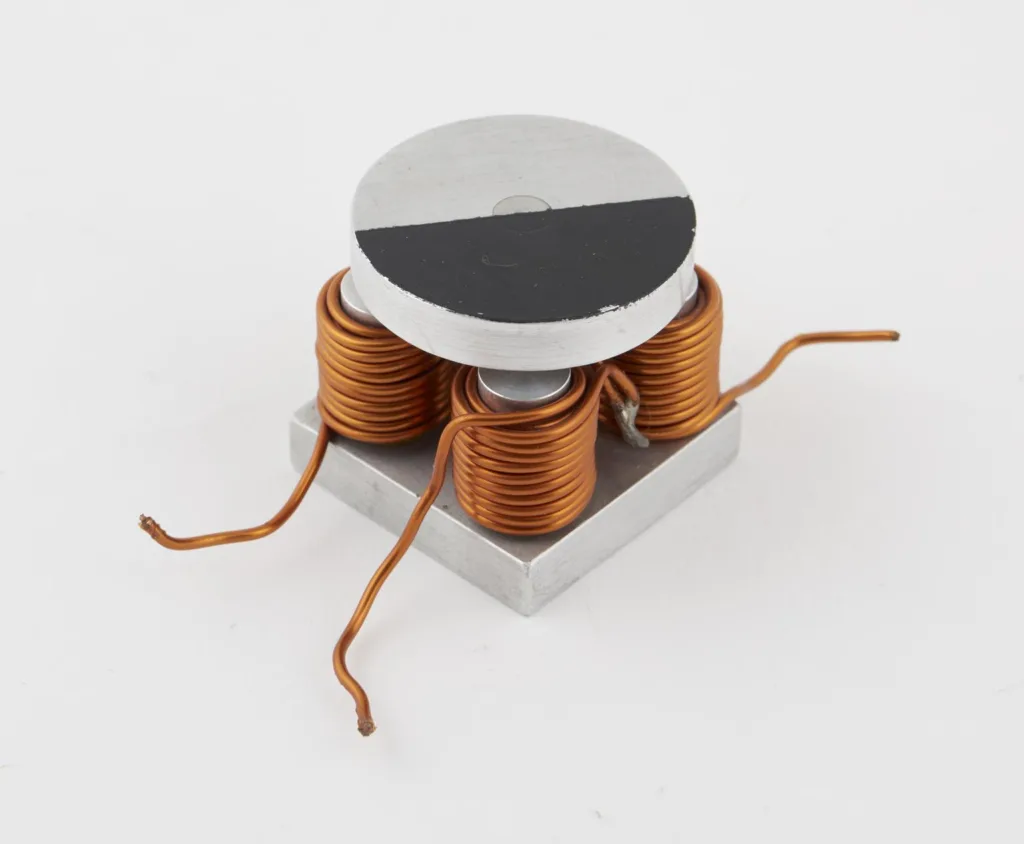
McLellan’s micromotor was designed to be as simple as possible while still being functional. He imagined four iron posts mounted on a plate, with each post wrapped in ultrafine copper wire to form electrical coils. Then, a small, magnetized rotor would be placed between the posts. When current was then applied in sequence to the coils, the rotor would spin. Sounds simple enough, right?
The Microworld
Working with materials on this scale introduces some unique problems beyond just the machining – difficult though that is.
One of them is the question of material purity. At larger scales, contaminants or imperfections in the base material are easily dismissed and will cancel out to zero over a sufficient area. But at micron scales, a single grain of dust becomes a relative mountain.
At this size, the effects of gravity decrease, while the effect of surface tension (van der Waals forces) becomes greater. The external environment works against the machinist in every way. A single breath of air becomes a hurricane, a heartbeat an earthquake. Vibration, thermal expansion, moisture – all of these factors become exponentially more difficult to control.
To this day we don’t know all the secrets of its manufacture. What is known is that in 1960, after 5 months of effort (!), William McLellan approached Dr. Feynman with his first prototype in a wooden box. Feynman, at first unimpressed, opened the box to find a microscope. And on the microscope was a slide, and on the slide, he saw this:
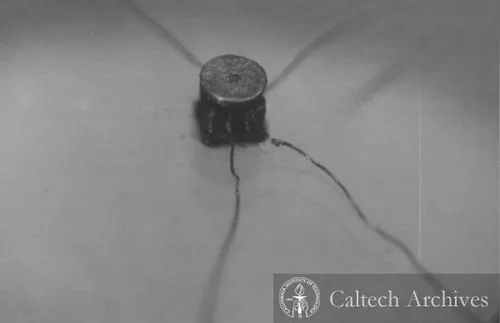
He pressed a button connected to a battery, and the rotor spun. Dr. Feynman was now much impressed and got out his checkbook on the spot. McLellan had won the prize, although he didn’t invent any new techniques in doing so, which was Richard Feynman’s hope. McLellan made ten prototypes which went to museums and private collectors. Today, the original at Caltech survives, the rest having vanished with the wind.
Oh, and the first challenge, about the Encyclopedia Britannica and the pinhead? Not claimed until 1984.
*Note that it’s the smallest motor made by humans. A single ATP molecule in a cell, which is a molecular motor, is 50,000 times smaller still. Mother Nature wins again.