
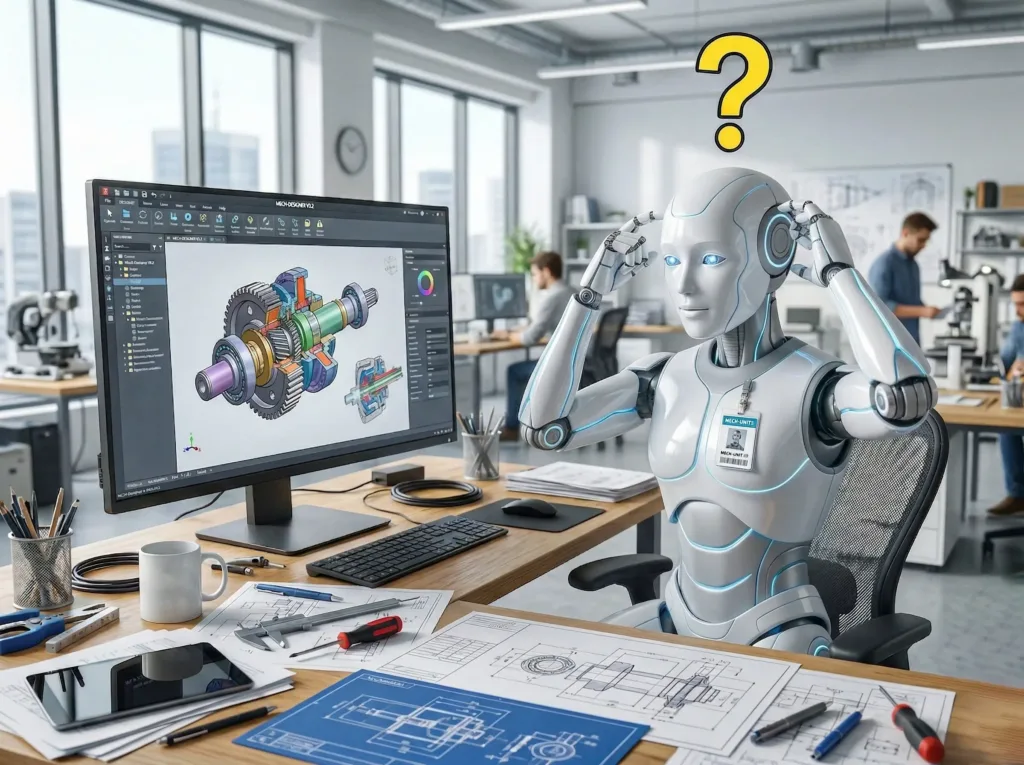
Artificial intelligence is rapidly reshaping how products are designed, but in precision engineering its limitations are just as important as its capabilities.
We’ll leave aside for now the debate over whether these systems are in fact intelligent, which may never be resolved to everyone’s satisfaction. What’s undeniable is that AI is increasingly being used in the design and engineering stage of precision manufacturing.
To get the most out of this technology it’s important to understand how AI thinks and why it’s not optimized (yet) for spatial reasoning. While there are some important caveats, learning smart implementation strategies can help you increase your design productivity while avoiding AI’s limitations.
Introduction to AI in Engineering
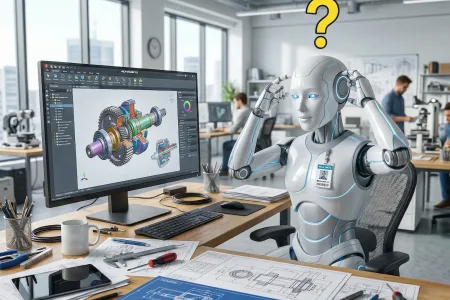
AI is making precision engineering faster and smarter, but it’s not magic. Machine learning algorithms can streamline some design work and cut down on repetitive coding tasks, sure. The real value isn’t in the flashy promises – it’s in the practical applications. Think of AI as a really good engineering assistant that doesn’t get tired and can crunch numbers faster than you can drink your morning coffee.
AI Systems Are Built on Words
However, large language models (LLMs) are not design tools in the traditional engineering sense. They don’t understand geometry, topology, or the parametric logic required to produce manufacturable parts.
Instead, all major LLMs are trained on a vast database of written content and rely on text as their primary input for generating responses and simulating reasoning by mixing and matching words based on context and historical precedent.
This makes them particularly good tools for working with large interconnected systems of established knowledge, since they can pull from many references quickly.
CAD Systems Rely on Geometry
Making a part by CNC machining or 3D printing requires a 3D CAD drawing, and this drawing must be watertight or manifold. That means every edge connects to exactly two faces with no holes or self-intersections.
LLMs don’t comfortably understand this. They often create non-watertight shapes that feature:
- Non-manifold edges
- Intersecting faces
- Duplicate vertices
- Gaps in surface continuity
These errors aren’t theoretical – they lead directly to failed toolpaths, rejected parts, and costly redesign cycles if not caught early.
The Challenge of GD&T
Geometric Dimensioning and Tolerancing also demands exact symbolic interpretation and functional reasoning about fit, form, and orientation. Precision engineering focuses on the design, development, and manufacture of products with high levels of accuracy and repeatability, ensuring that every component aligns with strict functional requirements.
Unfortunately, LLMs don’t know a design’s fitness for purpose and so are unable to interpret a design’s logic based on experience. This can lead to a series of errors including:
- Misinterpreting GD&T symbols
- Omitting datum references
- Assigning inconsistent tolerances
- Failing to propagate tolerance stacks correctly
It can be hard enough for a real engineer to get this right every time, and current AI systems are not reliable enough to do so without human review.
That’s why collaboration with manufacturing experts is essential early in the design stage and long before drawings are sent out.
Where AI Actually Adds Value in Precision Engineering
Having said all that, there are still several ways that today’s advanced AI models can help with design development if you understand and work within their limitations.
1. Explore design options
At the outset of a project, it may be tempting to quickly settle on a single solution to an engineering problem. This is especially true when entire teams are siloed and each has their own version of which direction is best.
To avoid narrowing down to a single solution too quickly, AI can offer several possible alternatives in materials or architecture to explore. Engineers can choose from a range of design options generated by AI, allowing for greater flexibility and customization.
It then becomes easy to make multiple design variations with just a few simple adjustments to the written prompts. At this point these designs don’t need to be perfect, just comprehensible.
In this way, valuable time is saved by not chasing after ideas that prove unfeasible.
2. Identify failure modes
AI systems can’t perform validated finite element analysis (FEA) or replace simulation tools. But they can help engineers think in a more structured way about what might lead to part failure or poor performance.
For example, when prompted, an AI chat can bring up a curated list of the most common design-dependent areas that engineers should double-check including:
- Wall thickness
- Material strength
- Load distribution
Again, this is not about a specific design but rather a set of high-level observations to guide critical thinking.
3. GD&T Checklists
Because of its importance in precision engineering and custom manufacturing, it’s essential that GD&T best practices are used consistently.
Remember that any missing or incorrect information on a design drawing can quickly become an expensive roadblock. An LLM can help to expedite drawings by asking:
- Where is datum A?
- How many degrees of freedom are there?
- Where is the part allowed to move, and where not?
- Which tolerances are critical?
- Which surface is most important for cosmetics?
The AI won’t know the right answers but it can prompt the right questions.
4. Bridging engineering disciplines
This can be really smart if done right. Complex assemblies may combine moving parts, rigid frames, electronics and hydraulics all in one, such as in a race car.
AI is particularly effective at system-level thinking. It’s therefore invaluable for identifying complex issues with alignment, hole locations, thermal distribution, torsion, and other features that, in a complete assembly, can migrate from one design domain and into another. AI can help teams realize their vision for complex assemblies by identifying issues that span multiple engineering domains.
These compatibility issues might otherwise be overlooked by separate design teams until much further downstream where they can be costly to repair. Again, collaboration with a manufacturer experienced in systems thinking is the best way to solve problems before they arise.
Effective product development in precision manufacturing requires close collaboration between design and manufacturing teams to ensure all aspects of the assembly are addressed.

CAD Designs and AI Agents
An emerging field is the use of AI agents for engineering support and design validation.
AI agents are automated programs that perform a series of operations based on your inputs and constraints. They combine some elements of LLM with engineering data such as BOMs, tolerances, and standards.
Think of them as structured, rule-driven workflows that relieve the engineer from burdensome and repetitive tasks. AI agents help teams stay focused and maintain workflow continuity throughout the design and validation process.
AI agents are purpose-built for this kind of work and are comfortable dealing with parametric data. However, they still need to be programmed by intelligent human operators who know exactly what they’re looking for.
For example, once an initial design has been developed, the agent can double-check the GD&T title blocks, look for tolerance ambiguities or missing callouts, and ensure consistency with company standards across multiple designs.
Quality management systems, supported by AI agents, provide traceability of materials and processes in precision manufacturing.
AI Agents Retain System Memory
This is important and often overlooked. Regular LLMs don’t retain long-term memory of a conversation unless specifically asked to do so. Every session with a chatbot starts with a blank canvas and often yields a different answer even when prompted with the same query.
In contrast, AI agents provide consistency and repeatability – important for businesses that need to maintain regulatory compliance. Consistency and repeatability are critical for business operations in precision manufacturing, ensuring reliable outcomes and supporting professional standards.
Humans in the Loop
Both LLMs and AI agents perform tasks based on calculations and algorithms, which can be great for doing the heavy lifting on repetitive jobs that require researching large datasets and identifying patterns.
This is where experienced manufacturing partners become critical: applying high-level reasoning based on context and experience. Precision manufacturing is essential for producing high-quality instruments used in medical and industrial applications, where accuracy and reliability are paramount. That’s why experienced engineers should always perform downstream verifications, identify GD&T inconsistencies, and repair broken 3D meshes.
Key Takeaways
LLMs and AI agents should be considered as tools that product developers can use at the start of a project. Bear in mind that they can’t develop parametric 3D solids independently. Trusting an LLM to create a CAD design based on verbal input is not a reliable approach.
Only people understand the physical 3D world and the complex way that real objects interact with one another. Cooperation and communication with manufacturing experts is key here for optimizing toolpaths and rectifying GD&T errors.
However, AI can still help with:
- Rapid design ideation
- Spotting missing or contradictory data
- Suggesting alternate methods or materials
- Identifying potential DFM issues
- Automating repetitive tasks
- Applying rules consistently
- Creating helpful reminders and checklists
Now you know how large language models should be used to help you become more efficient and confident with your own designs for precision engineering and manufacturing.
AI can accelerate early design thinking but it can’t validate manufacturability, tolerances, or real-world performance.
That’s where we come in.
When you’re ready to move from concept to production, our engineering team will review your design, identify risks, and ensure it’s optimized for manufacturing from day one.
Request a precision manufacturing quote today and trust the experts.