
Getting A Grip On Workholding Tips For Product Success
You’ve put valuable time and energy into preparing designs for a new product launch. The success of your project depends on CNC machining aluminum to high tolerances and getting your product on time and within budget.
Yet it seems no matter what you do, parts still come out of spec. Is it the toolpath, the cutter – or could it be the workholding?
A single misstep when CNC fixturing aluminum can pose big problems with tolerance integrity, along with generating higher scrap rates, longer lead times, and cost overruns.
That’s why product designers and their manufacturing partners should always collaborate to devise workholding techniques for aluminum machining long before the chips start to fly.
Today we’ll look at why these problems happen and how superior service providers can solve them to provide high-precision CNC machined aluminum parts.
Understanding The Properties of Aluminum Alloys
Every aluminum alloy offers its own balance of strength, stiffness, and machinability – all of which influence how the part must be held during CNC operations.
| Material Group | Material Name | Density (g/cm3) | Hardness (Brinell) | Tensile Strength (MPa) | Weldability | Machinability % |
|---|---|---|---|---|---|---|
| Aluminum | 1100-H112 | 2.8 | 23 | 90 MPa | Good | 50% |
| Aluminum | 2014-T6 | 2.8 | 120 HB | 483 MPa | Poor | 70% |
| Aluminum | 2024-T3 | 2.78 | 120 HB | 470 MPa | Poor | 45% |
| Aluminum | 2024-T351 | 2.78 | 120 HB | 470 MPa | Poor | 45% |
| Aluminum | 5052-H112 | 2.7 | 60~80 | 193 MPa | Good | 60% |
| Aluminum | 5052-H32 | 2.8 | 70~90 | 228 MPa | Good | 65% |
| Aluminum | 5083-H112 | 2.8 | 95 - 115 HB | 275 MPa | Yes | 55% |
| Aluminum | 6060-T6 | 2.8 | 80 | 190 MPa | Yes | 70% |
| Aluminum | 6061-T6 | 2.8 | 95 HB | 310 MPa | Excellent | 65% |
| Aluminum | 6061-T651 | 2.8 | 95 HB | 310 MPa | Excellent | 65% |
| Aluminum | 6063-T6 | 2.8 | 73 HB | 245 MPa | Excellent | 75% |
| Aluminum | 6082-T6 | 2.8 | 89 HB | 330 MPa | Good | 70% |
| Aluminum | 6082-T651 | 2.8 | 89 HB | 330 MPa | Good | 70% |
| Aluminum | AL7075-T6 | 2.81 | 150 HB | 570 MPa | Poor | 45% |
| Aluminum | AL7075-T651 | 2.81 | 150 HB | 570 MPa | Poor | 45% |
For example, alloys with a T6 temper have been stress-relieved, making it easier to predict their behavior and control tolerances. And some, such as 6061-T651 aluminum, have also been stretched, meaning their microcrystalline structure has a linear orientation. This too will affect how the material behaves under clamping pressure.
Therefore, the first order of business when making precision machined parts is to understand what type of alloy you’re dealing with, and from there develop fixturing strategies based on its specific characteristics and the product design.
No matter the alloy or temper, there are always going to be the following complex set of interacting physical forces that need to be accounted for on every project.
Deflection
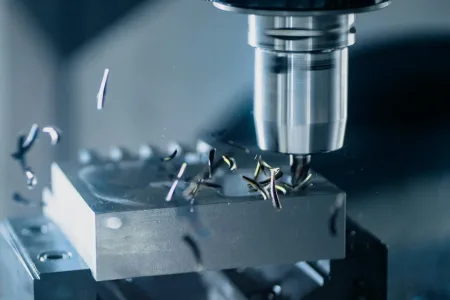
During CNC machining, whenever a cutting tool engages with the workpiece it causes the material to deflect away from the pressure of the tool. The amount of deflection depends on many factors including thickness, the speed and feed of the tool, the profile of the cutter, and the material properties.
The purpose of workholding is therefore not just to resist this deflection but to manage it – to guide its direction and intensity so that it doesn’t adversely affect any critical tolerances.
And of course, a fixture must do this without interfering with the progress of the cutting tool or damaging the part.
Vibration
CNC milling imparts vibration to the workpiece which can be seen in the tool marks left behind on the part.
The amount of vibration fluctuates based on the cutting speed and pressure, as well as tool sharpness. Of course, thin-walled aluminum parts amplify vibration, meaning workholding must stabilize without distorting.
Heat
Because aluminum is such a good conductor, heat is readily transferred through the part during machining. This means parts expand and distort, adversely affecting tolerances.
For this reason, cutting fluid is almost always used during precision aluminum machining. Cutting fluid doesn’t just cool the part down, but also lubricates and helps distribute heat evenly, preventing any ‘hot spots’.
The Challenge of Rigidity
In order to deal with the above forces, CNC machinists and engineers use several techniques to try to hold the workpiece rigidly. However, if done incorrectly, poor workholding techniques can create more problems than they solve:
- Over-tightening: Excessive clamping force distorts the piece, especially on thin-walled areas.
- Poor fixture design: Blocking the flow of coolant causes hot spots and may also prevent chip evacuation.
- Inadequate support: Asymmetrical designs and thin walls need extra attention.
- Lack of repeatability: Custom set-ups can make it difficult to achieve consistency across many parts.
- False economies: Money saved using generic workholding vices will quickly be lost as scrap rates increase.
Ready to machine precision CNC parts with confidence?
Upload your drawings for a free quotation from Procision Manufacturing.
To achieve better aluminum CNC machining results, reputable manufacturers anticipate the material’s behavior and devise holding solutions by following these best practices.
Design For Manufacturing (DFM) review
The single most valuable step is to perform a design for manufacturability (DFM) analysis of the design to optimize it to suit the requirements of the machining process.
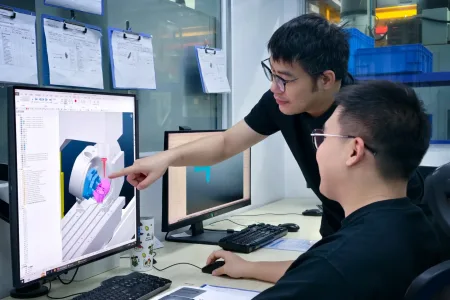
Engineers do this by understanding the part’s specifications, features and tolerances. Then they combine sophisticated computer modeling software and their own experience to predict where heat build up and distortion is likely to occur.
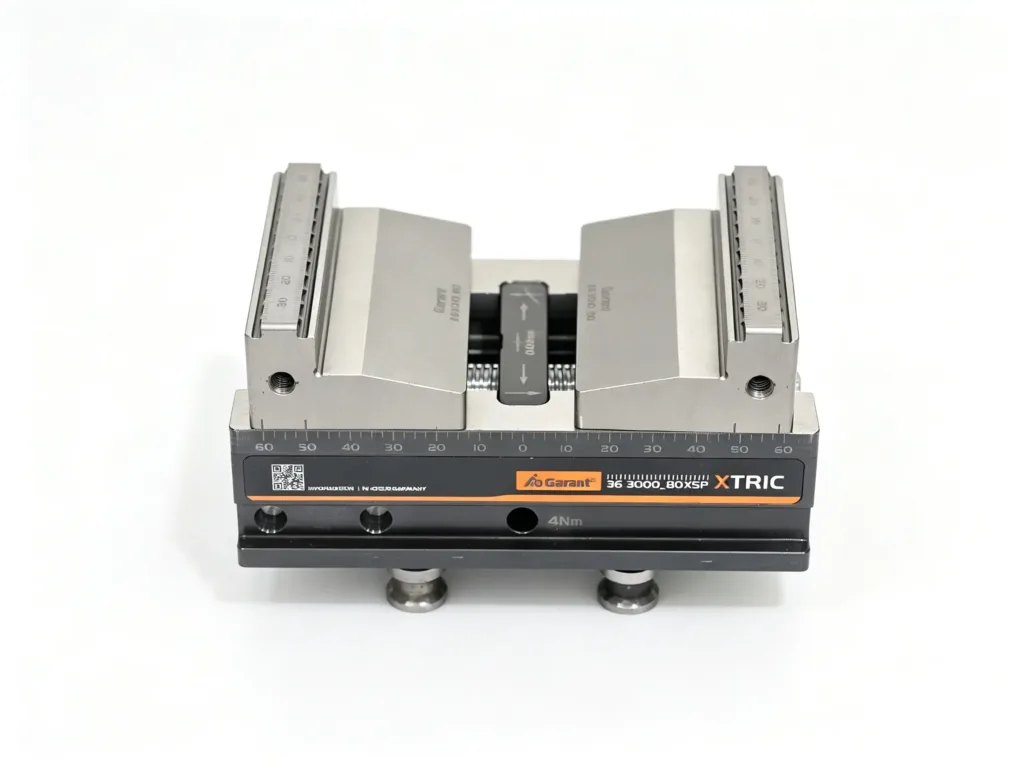
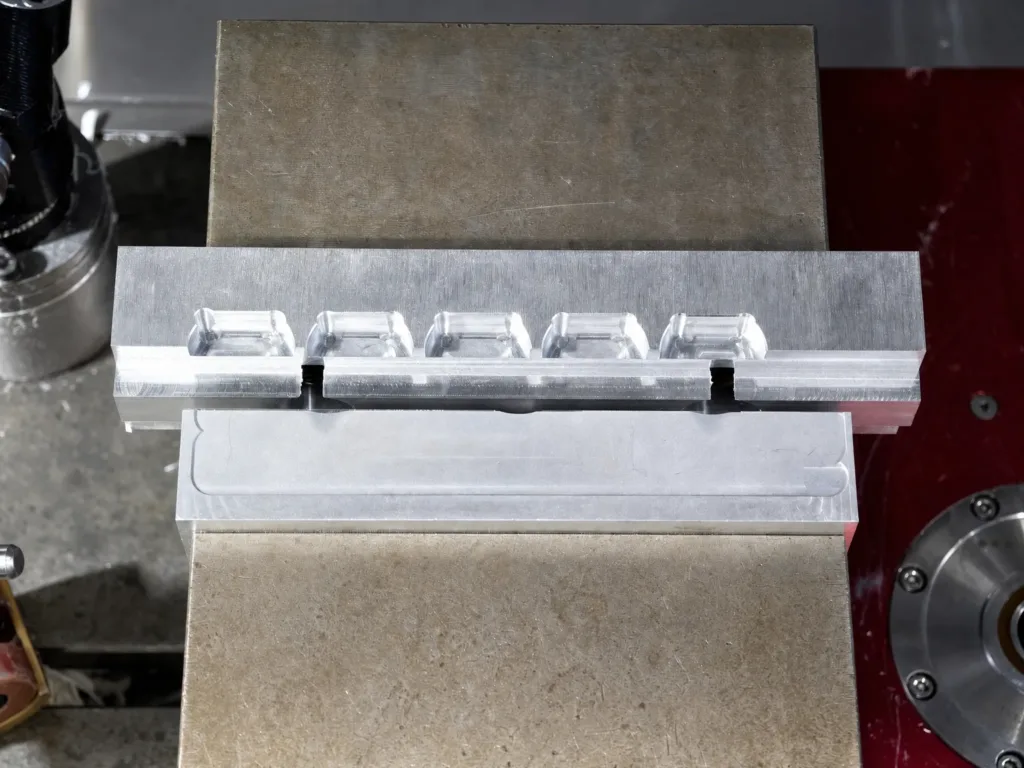
Soft jaws
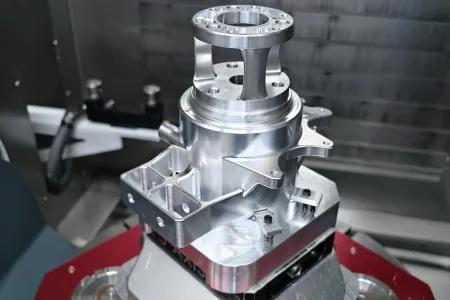
A soft jaw is one that’s either been machined to exactly match the contour of the workpiece, or which conforms itself to the shape as it’s tightened. This is the most accurate way to fixture complex geometries.
Soft jaws are a mainstay of aluminum CNC machining because they balance secure grip with surface protection. And note that soft jaws are not necessarily “soft” relative to the hardness of the workpiece – it refers to the fact that they are not heat-treated.
Vacuum clamps
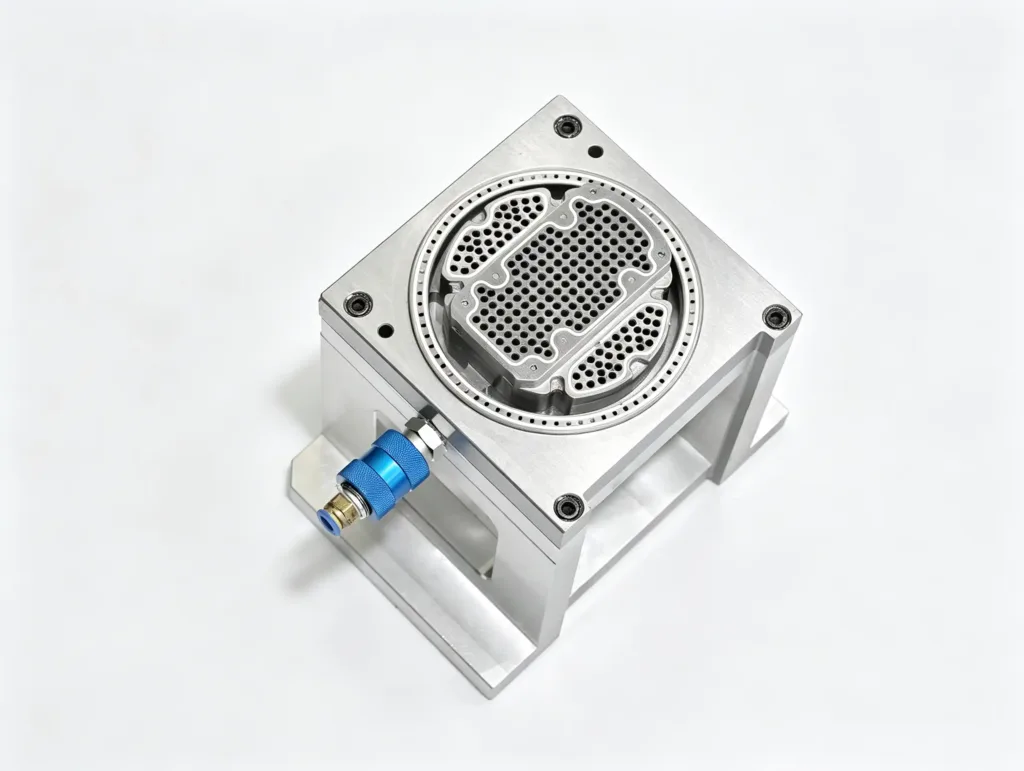
Magnetic clamps don’t work with aluminum, but it’s possible to use vacuum clamps instead for some projects.
There are several advantages to vacuum clamps. For one, there’s no need to invest in making a separate workholding tool.
Also, they’re very easy to set up and demount, and there’s little chance of damaging the workpiece. Finally, since the holding force is applied from only one side, the rest of the part is clear of obstructions, thus making it easier to machine around it.
There are a few drawbacks, though. One, the workpiece must have a solid, flat face to which vacuum can be applied. It will therefore not be possible to machine this face without remounting in a different fixture. Two, the degree of holding force is limited to atmospheric pressure, so heavy cuts that remove a lot of material don’t work with this process.
Custom fixtures and quick-change systems
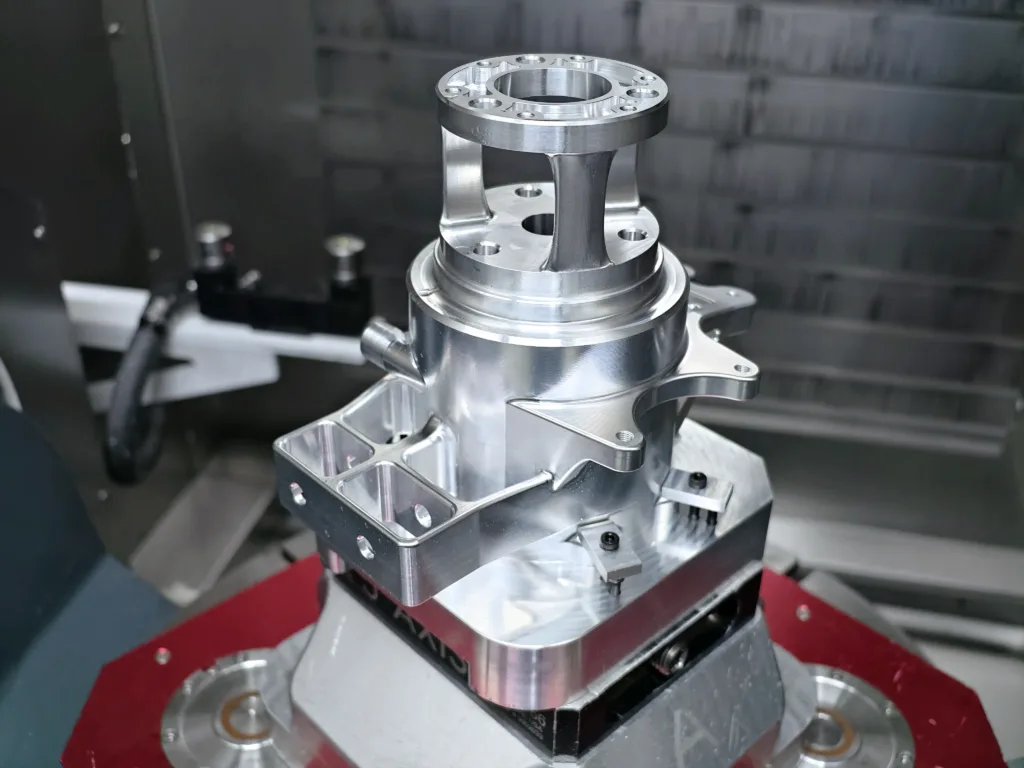
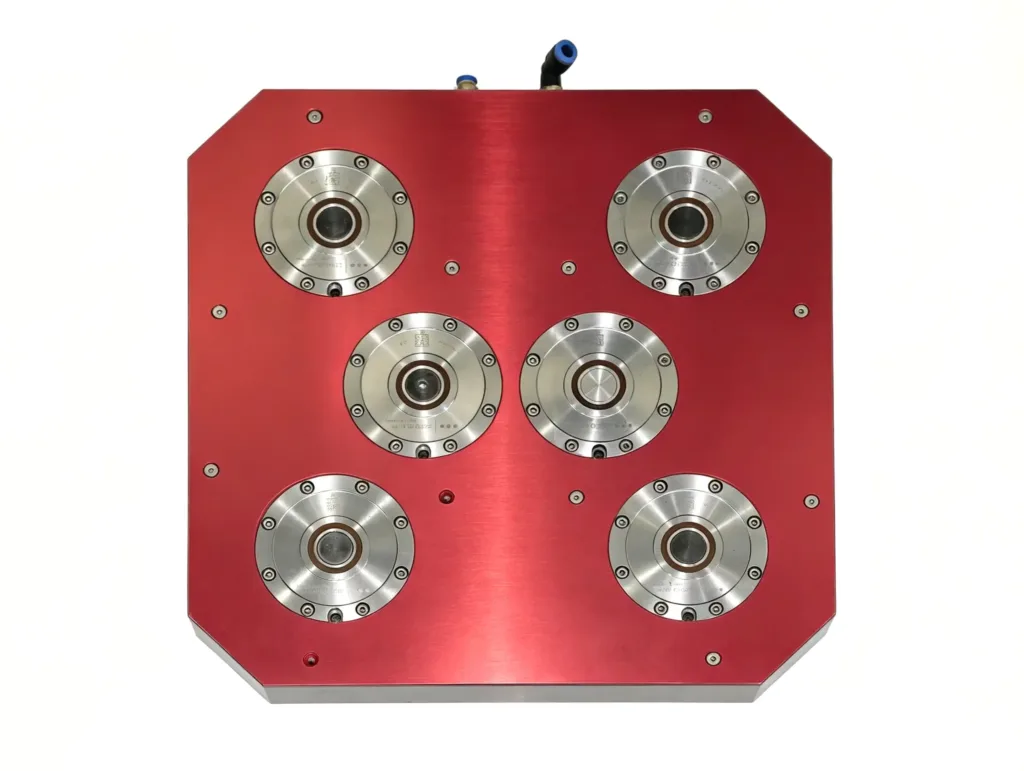
There’s no denying that some shapes are complex and simply can’t be effectively held in any generic workholding vice or clamp. Supporting them means making custom fixtures, and this can be a great advantage in many ways.
In means the machinist can optimize the workholding strategy to add critical support to thin walled or delicate features that would otherwise be difficult to keep in tolerance. They can also dissipate holding forces over a larger surface area to manage stress and heat – precisely in line with the part’s unique shape and mass.
Another advantage is that a fixture, once developed, makes it easy to mount and unmount a part while maintaining accuracy. At Procision, we frequently engineer dedicated fixturing to shorten cycle times and ensure part-to-part consistency in production runs.
It’s true that custom fixtures take longer to prepare and cost more. But they’re a wise investment when dealing with larger orders where consistency and production efficiency are paramount.
How Can Designers Support Better Workholding?
So far, we’ve discussed workholding solutions that rely on making or modifying external tools or fixtures to fit the requirements of the part.
But there are also several things that product designers can do to modify their designs to suit the needs of the machinist and the process. This is another reason why close cooperation and clear communication between developer and manufacturer can help resolve workholding issues before they occur.
Relax critical tolerances
By clearly understanding the design intent and environment, it’s often possible to relax critical tolerances and still achieve perfect functionality and performance. This helps reduce the scrap rate, lead time, and cost.
We’ve seen this so many times. We receive a set of CAD files and there are critical tolerances everywhere, on virtually every angle and feature, all competing for attention. We know from experience that many critical dimensions means tolerance stacking and a much higher scrap rate. But in most applications, they aren’t necessary and are even counterproductive.
Design for fixturing
Because workholding is so critical for maintaining consistency and accuracy, why not incorporate it directly into the product? This can be done by adding flat features on opposing faces, which provides a place to clamp on to.
Similarly, some CNC machined aluminum parts can be cut from a single block, the bottom acting as a temporary pedestal base. This base is mounted in a workholding fixture and then cut free after the main machining work is finished.
Open dialogue between designers and machinists turns workholding from a constraint into a performance advantage.
Partner with Procision to eliminate tolerance drift and improve yields in aluminum CNC machining. Upload your CAD files for a free quotation today!