If you’re developing a plastic part and need it to perform as it should, material selection is one of the earliest and most important decisions you’ll make.
In injection molding, the material is not something to choose after the tool is designed. The resin helps determine shrinkage, cooling behavior, tolerances, surface finish, and overall part performance.
In many cases, more than one material can work, so the goal is not to find a single “best” plastic, but the best fit for your application and environment.
This guide explains how to evaluate thermoplastic materials in practical terms, so you can move forward with more confidence and fewer surprises.
Key Takeaways
- Choosing the right plastic resin is critical because poor selection leads to part failure, poor performance, and higher costs.
- Thermoplastics are the standard for injection molding due to their reusability and flexibility.
- Material selection should be based on key factors such as strength, heat resistance, chemical exposure, appearance, volume, and regulatory requirements.
- Successful material selection is a collaborative process with your manufacturer, using DFM reviews and prototyping to catch issues early and avoid costly mistakes.
Thermoplastics Used in Injection Molding
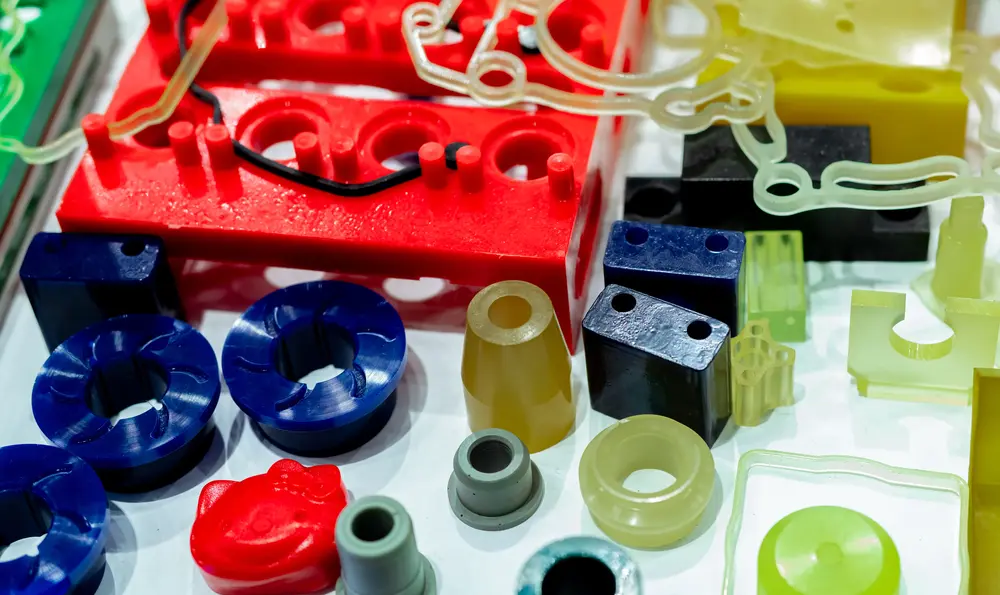
Almost every plastic injection molding project uses thermoplastics, and for good reason.
Thermoplastics soften when heated, flow into the mold, and solidify when cooled, which makes them well suited to repeatable, high-precision manufacturing.
They also offer a wide range of performance characteristics, from impact strength and flexibility to heat resistance, chemical resistance, and cosmetic finish.
That’s why for custom plastic injection molding services, thermoplastics are the material of choice.
The Most Common Resins in Plastic Injection Molding
Here are the seven most widely used resins in plastic injection molding services, and what each is best suited for:
Material, | Best For | Key Trait |
ABS | Electronics, housings, consumer goods | Strong, impact-resistant, and great surface finish |
Polypropylene (PP) | Food containers, living hinges, packaging | Flexible, chemical-resistant, food-safe |
Polyethene (PE / HDPE) | Bottles, caps, simple shapes | Affordable, moisture-resistant, and easy to mold |
Nylon (PA) | Gears, mechanical parts, under-hood auto | High strength, wear-resistant, heat-tolerant |
Polycarbonate (PC) | Safety helmets, lenses, protective covers | Tough, optically clear, impact-resistant |
Acrylic (PMMA) | Display cases, light covers, signage | Crystal clear, UV stable, lightweight |
Acetal / POM | Medical devices, precision parts, fasteners | Rigid, low friction, tight tolerances |
Procision Manufacturing supports a wide range of thermoplastics and engineering resins, including common materials like ABS and polypropylene, as well as high-performance options like PEEK.
6 Factors That Drive Your Material Choice
Choosing the right resin means matching the material to how the part will actually be used. A good choice supports part performance, manufacturability, cost control, and any compliance requirements from the start.
Mechanical Strength
Mechanical strength determines whether a part can withstand impact, carry loads, or withstand repeated flexing without cracking or deforming. This matters most for functional features such as clips, brackets, housings, hinges, and snap-fits that are regularly stressed during assembly or use.
Heat Resistance
Heat resistance determines whether a part maintains its shape and strength when exposed to high temperatures. If the application involves engines, hot water, steam, or nearby heating elements, the resin must maintain dimensional stability under those conditions.
Chemical Resistance
Chemical resistance is critical when the part may come into contact with oils, grease, detergents, solvents, acids, or other aggressive substances. A resin that is not compatible with its environment can discolor, swell, become brittle, or fail much earlier than expected.
Appearance
Appearance matters when the part is visible to customers or must meet specific cosmetic requirements. Resin choice can affect transparency, gloss, surface texture, and color consistency, so visual expectations should be defined early rather than treated as a secondary concern.
Production Volume
Production volume influences whether a material makes sense economically over the life of the project. For large runs, commodity resins such as PP or PE often provide a better balance of performance and cost, while lower-volume or specialized parts may justify a higher-performance engineering resin.
Regulatory Standards
Regulatory standards can quickly narrow the list of suitable materials. If the product must meet requirements such as FDA, RoHS, or UL, the selected resin needs to be available in grades that support those standards and fit the intended application.
These factors should be reviewed together, because the best material is rarely the one that leads in only one category. A good plastic injection molding service provider should help evaluate these during the DFM review and recommend a resin that fits both the part and the production plan.
Material Selection is a Team Effort
Resin selection isn’t something you do alone – and you shouldn’t have to. The best custom plastic injection molding services treat material selection as a collaborative process between your design team and their engineering team.
Here’s what that collaboration looks like in practice:
- DFM Review: Before production begins, your manufacturer reviews your design for manufacturability. This is when material suitability gets flagged – if your chosen resin won’t fill the mold properly, shrinks too much, or can’t handle your operating environment, it gets caught here, not after production.
- Resin Expertise: Experienced manufacturers have worked with hundreds of resins across industries. They know which materials perform well in aerospace, medical, automotive, and electronics — and which ones cause problems.
- Sampling and Small Batch Runs: Before committing to a full production run, it may make sense to validate your material choice through sampling or a small batch. This is especially important for new part designs or unfamiliar resins. In injection molding, this is different from typical prototyping, since molded parts still require a mold tool investment in time and money.
- Pushback When Needed: A trustworthy manufacturer will tell you when your material spec isn’t right – even if it’s not what you want to hear. That’s a sign of a real engineering partner, not just a vendor.
Procision Manufacturing offers DFM review and technical support across prototyping and production from concept through production with ISO-certified quality and no minimum order restrictions.
Common Mistakes to Avoid
Even experienced teams get material selection wrong. Here are the most common mistakes and how to sidestep them:
- Choosing by price alone. Cheaper resins save money upfront but can cost far more in failed parts, rework, and returns. Balance material cost against part requirements.
- Ignoring the operating environment. A plastic that performs beautifully at room temperature may warp near a heat source, crack in cold weather, or degrade when exposed to cleaning chemicals. Always design for the environment the part will actually live in.
- Skipping the prototype stage. Committing to full-scale production without testing your material choice is a risk you don’t need to take. Small prototype runs surface problems cheaply.
- Leaving compliance to the end. If your part needs to meet FDA, RoHS, UL, or ISO standards, material selection must reflect those requirements from the start, not after.
Work With a Manufacturer Who Knows Plastic Molding
The right plastic resin makes the difference between a part that works and one that doesn’t. But you don’t have to navigate hundreds of material options on your own.
Procision Manufacturing‘s engineering team works with you from the earliest stages of your project , reviewing your design, recommending materials, and flagging issues before they become expensive problems.
With ISO-certified quality, DFM support, access to hundreds of resins, and no minimum order restrictions, Procision is built to be a long-term manufacturing partner, not just a parts supplier.
Ready to find the right material for your next project?
Work with a Custom Plastic Injection Molding team that can review your design, recommend the right resin, and flag manufacturability issues before they become production problems.