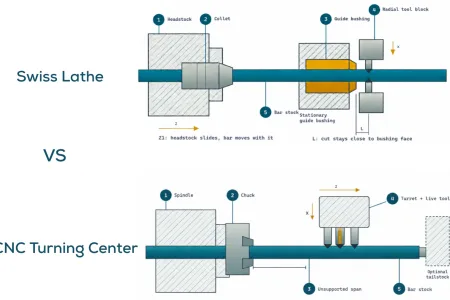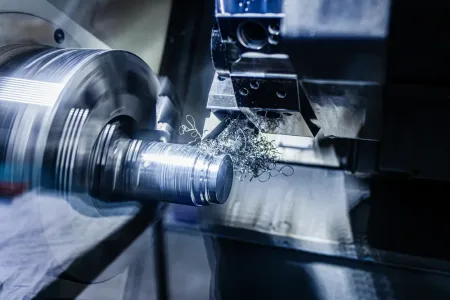

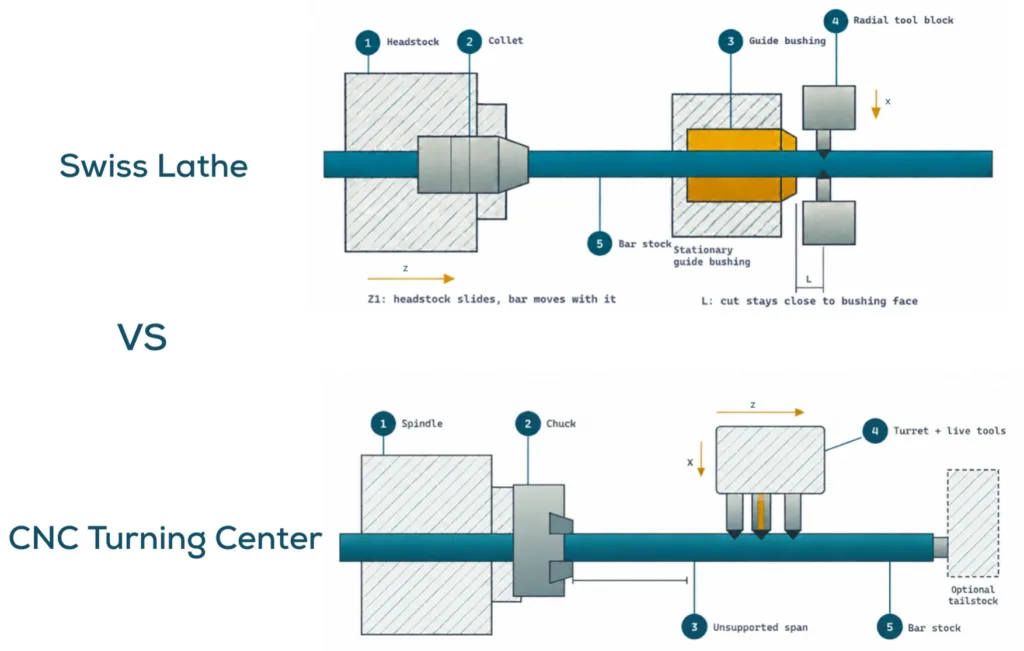
Unlike conventional CNC turning centers, Swiss-type lathes are designed with a unique machine architecture that supports very thin bar stock with high rigidity. This enables them to fabricate small diameter parts, typically under 32mm, with complex features and very tight tolerances in a way conventional machines cannot match.
Product engineers use Swiss lathes to make precision components for aerospace, medical, robotics, automotive and more. These machines also support live tooling and back machining to perform additional milling tasks in a single set-up, further enhancing their versatility.
Let’s break down how these specialized machine tools work and the types of components they’re ideal for.
What are the main features of a Swiss lathe?
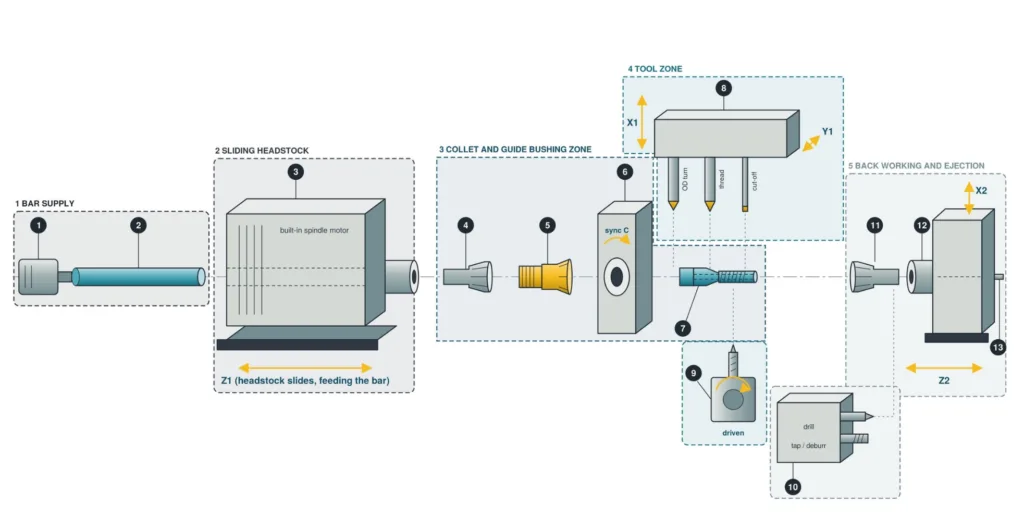
Section 1: Bar supply
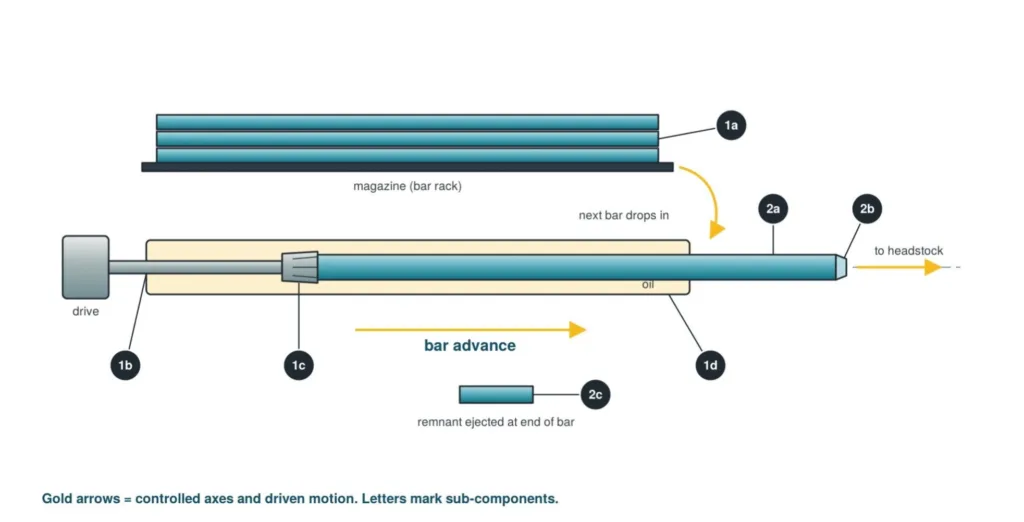
- 1a: A bar feeder supplies the machine with a steady supply of prepared stock.
- 1b/1c: Raw material is held in a chuck and pushed forward into the headstock when needed, immediately behind the previous bar.
- 1d: The bar channel is filled with oil to dampen vibration at high speeds.
- 2a: The opening of the guide bushing will only permit bar stock that fits within a narrow tolerance range, so the material must be precision ground bar.
- 2b: A clean collet entry is provided by a chamfered end on the bar stock.
- 2c: There is always a small remnant of bar stock ejected as scrap.
Section Two: Sliding headstock
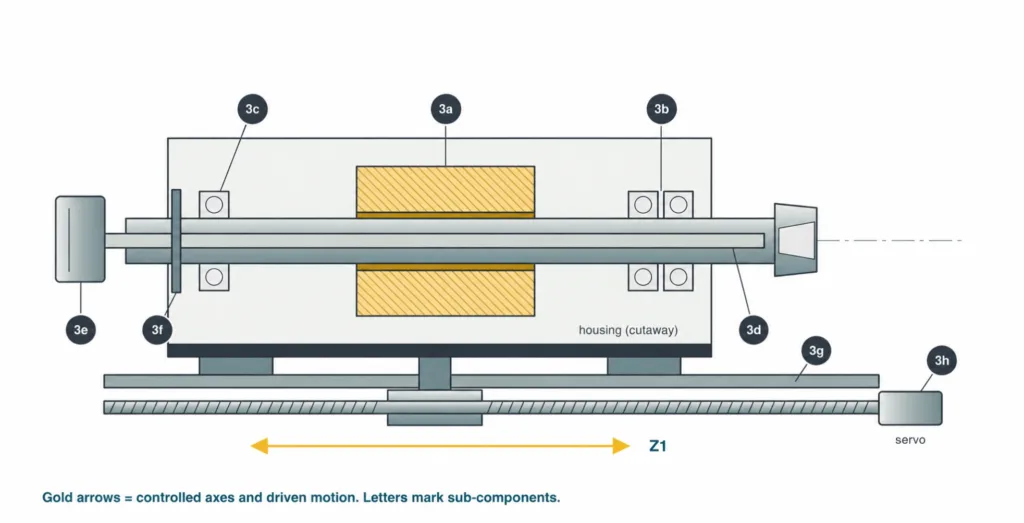
- 3a: The spindle motor is mounted directly on the spindle itself for very fast acceleration and control on the C-axis.
- 3b/3c: Part concentricity is supported by the use of precision angular contact bearings.
- 3d/3e: At the spindle nose, the main collet is opened and closed by the draw tube and actuator.
- 3f: The C1 rotational position is controlled by a dedicated encoder. This allows precise drillingand millingusing live tools on the workpiece.
- 3g/3h: Motion along the Z-axis pulls the bar through the guide bushings. The headstock rides on precision linear guides.
Section Three: Collet and guide bushing zone
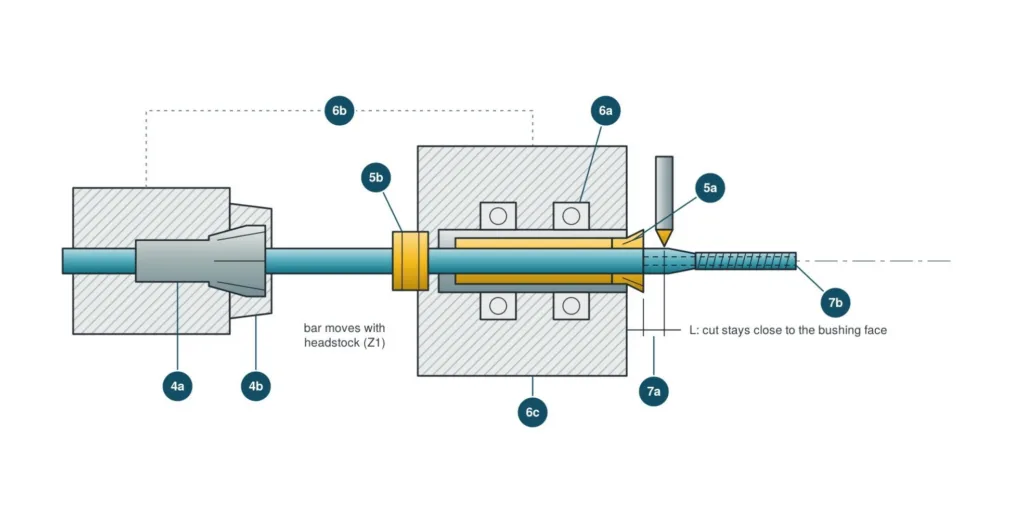
- 4a/4b: The bar is held in an exact position by the main collet and the nose cap.
- 5a: A guide bushing typically sits immediately behind the cut.
- 6a/6b: Heat build-up and friction on the bar are reduced by bearings that support the bushing and drive it with the main spindle.
- 6c: The moving spindle is well-supported by the machine bed, so travel only happens in the Z direction.
- 7a: Accuracy derives from the cut point being located just in front of the bushing face to avoid deflection.
- 7b: Swiss lathes excel at making complex parts with both turned and milled features.
Ready to start your Swiss turning project?
Upload your drawings for a free quotation from Procision Manufacturing.
Section Four: Tool Zone
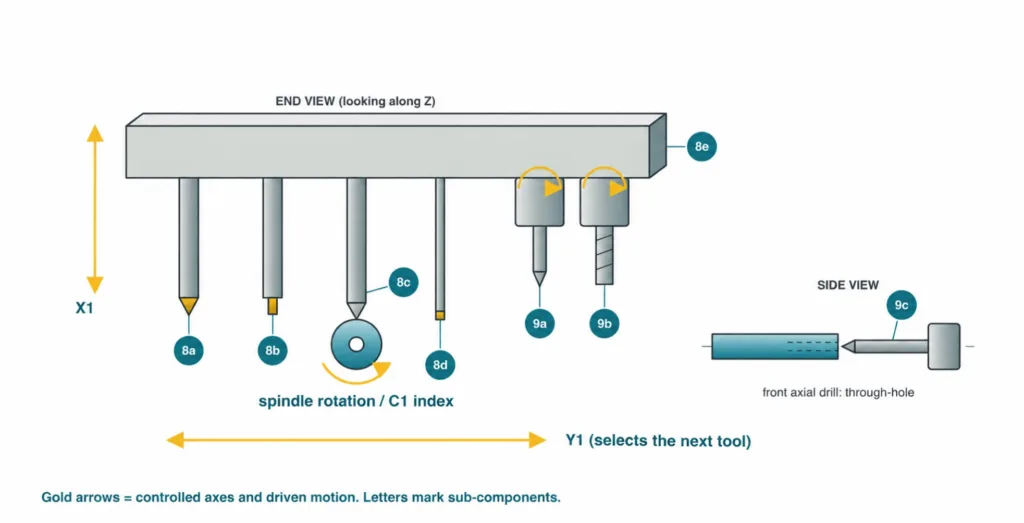
- 8e: The use of a gang slide makes it easy to bring tools to bear against the work surface very quickly and accurately, unlike the indexing of a turret.
- 8a to 8d: A typical set-up might include diameter turning, grooving, threading and cutting off.
- 9a/9b: Live tools can perform milling and turning when the main spindle is locked on the C1 axis.
- 9c: Tools mounted on the front holder can also drill axially before cut-off.
Section Five: Back working and ejection
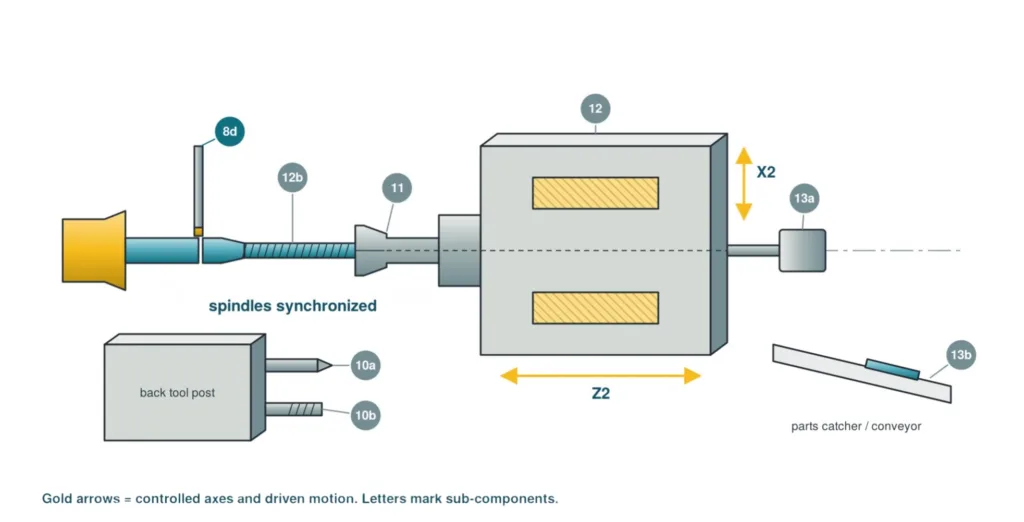
- 12b: The sub-spindle moves along the Z-axis to grab and hold the part securely while also spinning in exact sync with the main spindle. Then the back of the part can be cut-off without damage.
- 10a/10b: Once the part is free, the sub-spindle retracts and shifts on X2. This allows for drilling, tapping or deburring on the back side.
- Back side working takes place at the same time that a new part is being prepared, so the longer of the two sequences determines final cycle time.
- 13a/13b: An ejector rod is used to push out the finished part.
What is the difference between Swiss turning and conventional CNC turning?
| Topic | Swiss-Type Lathe | Conventional CNC Lathe |
|---|---|---|
| Workpiece support | The collet grips the bar, and a guide bushing supports it just behind the cutting tool. | The workpiece is held in a chuck while the tools move along its length. |
| Tooling | Tools on a rigid gang slide move in X and Y. The bar supplies the Z motion, so changing tools is a short, fast linear move. Many models also add a turret. | Tools sit on a turret that must index to each tool, which takes longer. |
| Controlled axes | Typically 5 to 13 axes. | Typically 2 to 4 axes on standard turning centers. Multi-tasking, twin-spindle models have more. |
| Simultaneous machining | The sub-spindle back-works one part while the main spindle machines the front of the next. | Back-side features usually need a second operation or re-chucking, unless the machine has a sub-spindle. |
| Diameter range | Small diameters, typically up to 32 mm, with some models to 38 mm. | Much larger diameters and heavier stock. |
| Bar remnant | Leaves a remnant at the end of each bar, typically longer than on a conventional lathe. | Bar-fed work also leaves a remnant, usually shorter. |
| Bar stock | Requires precision ground, tight-tolerance bar when running with a guide bushing. | Accepts standard bar, castings, forgings, and cut blanks. |
| Programming and setup | More complex. Several tools and spindles must be coordinated across many axes. | Simpler and faster to program and set up. |
| Heat and chips | The small, crowded work zone makes heat and chip evacuation harder. | The larger work envelope makes heat and chip control easier. |
| Length-to-diameter (L:D) ratio | About 20:1 in normal production, with no tailstock or steady rest. | About 3:1 chuck only, up to 6:1 with a tailstock, and up to 12:1 with a steady rest. Tolerances get looser beyond this. |
| Tolerance (microns) | Typically ±5 to ±13 µm; ±25 µm is considered loose for Swiss work. Down to ±2.5 µm on critical diameters. | Typically ±25 to ±76 µm (default ±127 µm). Down to about ±13 µm on critical features. |
What are some examples of common Swiss cnc turned components?
Medical and dental
- Bone screws
- Dental implants
- Surgical instruments
- Catheters
- Hypodermics
Aerospace
- Fuel system fittings
- High-performance fasteners
- Connector pins
- Sensor housings
- Precision bushings
Electronics and electrical
- Connector contacts
- Conductors
- Probe pins
- Terminal posts
- Thermocouples
Automotive
- Injector nozzles
- Brake parts
- Valve spools
- Sensor housings
- Attachment hardware
Hydraulics and pneumatics
- Valve poppets and seats
- Precision fittings
- Nozzles
- Pistons and plungers
Consumer, Watches, and Optics
- Watch movements
- Pen parts
- Lens mounts
- Hinge screws
- Alignment screws
Industrial and general
- Precision shafts
- Spacers and sleeves
- Threaded inserts
- Encoder shafts
What materials can you use with Swiss turning?
- Stainless steel
- Titanium
- Brass
- Aluminum
- Inconel
- PEEK
A complete Swiss turning solution
At Procision, our we offer production engineers more than just Swiss-type lathe turning services. For a more complete product solution, combine Swiss turning with CNC milling and CNC turning, plastic injection molding, polyurethane vaccum casting and a full range of post-machining finishing services.
We support low-volume manufacturing as well as full mass production. Not sure where to begin? Talk to one of our specialists today.